

The short version
Traffic measures attention. Enquiries measure whether your website is doing its job, and most B2B sites are built for the first.
The leaks are nearly always the same: a vague first line, service pages that dodge the buyer's questions, one "Contact us" button for every visitor, and no record of which enquiries became clients.
Good B2B website lead generation is mostly fixing what is already there, in that order, before paying for a single extra visitor.
Your website looks professional. Analytics shows a steady line of visitors. The services are all there, neatly listed. And the phone stays quiet.
We hear a version of this in almost every first conversation with a B2B company. The site cost real money, the traffic report looks healthy, and the sales team says the website has never sent them anything worth chasing.
The problem is rarely the traffic. It is that the site was built to be looked at, not to start a conversation. B2B website lead generation is a different job from looking good, and it fails in a handful of predictable places. Here they are, in the order we would fix them.
Traffic is attention, not business
A thousand visitors a month sounds like a lot. It means very little until you know who they were.
A manufacturer's blog post on industry terminology can pull in students from three continents. A freight broker's page explaining the Incoterms rules attracts people who will never ship a pallet. Both look excellent in a traffic report. Neither produces a sales conversation.
Search makes the gap wider. Someone typing "what is digital marketing" is doing homework. Someone typing "B2B marketing consultant for manufacturers" has a budget and a problem. Both count as one visit. Only one of them is buying.
“The number that pays for a website is how many of the right visitors put their hand up.”
A visitor starts to matter when five things are true at once:
They are in a market you serve. Right country, right sector, right size.
They have a real need. Not curiosity, not a school project.
They can buy. There is a budget, or there will be.
They are part of the decision. The person reading is someone the buyer listens to.
There is a reason to talk now. A contract ending, a launch, a problem that will not wait.
We know the temptation of the big number from our own work. When we rebuilt the brand and website for Confidex, a Riga logistics broker, traffic rose 120%. We are glad to quote it. But traffic is where the measuring starts, not where it ends.
So before buying more traffic, find out what the site does with the traffic it already has. That is where B2B website lead generation starts. The number that pays for a website is how many of the right visitors put their hand up.
Say what you do in one sentence
Most B2B home pages open with a line that could belong to anyone. "Innovative services for a changing world." "Your trusted partner for excellence." They feel safe because they say nothing. Saying nothing is never safe.
A visitor gives your first screen a few seconds to answer three questions. What do you do? Who is it for? Why should I care? Miss one and they go back to the search results.
For example, take two freight brokers. The first opens with: "We provide comprehensive logistics services worldwide." The second: "Temperature-controlled road freight between the Baltics and Scandinavia, quoted within the hour." The second gives you the service, the route and the promise in twelve words. If you ship chilled goods from Riga to Stockholm, you keep reading. If you don't, you leave quickly, which is also useful.
The same habit runs down the rest of the page. Many B2B sites give their best space to company history, headcount and awards. Those details build trust, but they answer the company's questions, not the buyer's. The buyer wants to know whether you can fix their particular problem, whether you understand their industry and what working with you involves.
The test. Read your home page headline aloud to someone outside your business. If they cannot tell you what you sell and who buys it, rewrite it. Clever is optional. Clear is not.
Service pages should answer the buyer
A service page with a heading, a stock photo and two paragraphs of adjectives cannot carry a decision worth tens of thousands of euros. B2B buyers arrive with questions, and every question you leave unanswered is a reason to open a competitor's site.
A service page that sells usually covers seven things, in roughly this order.
1. The problem. Described the way the customer would describe it, not the way your team does.
2. What you do about it. The service, in plain words.
3. How it works. The steps, the timeline and who does what.
4. What they get. Deliverables someone could tick off a list.
5. Proof. A case study, a named client, a number.
6. The awkward questions. Price range, contract length, coverage, and what happens if something goes wrong.
7. One clear next step. More on that in the next chapter.
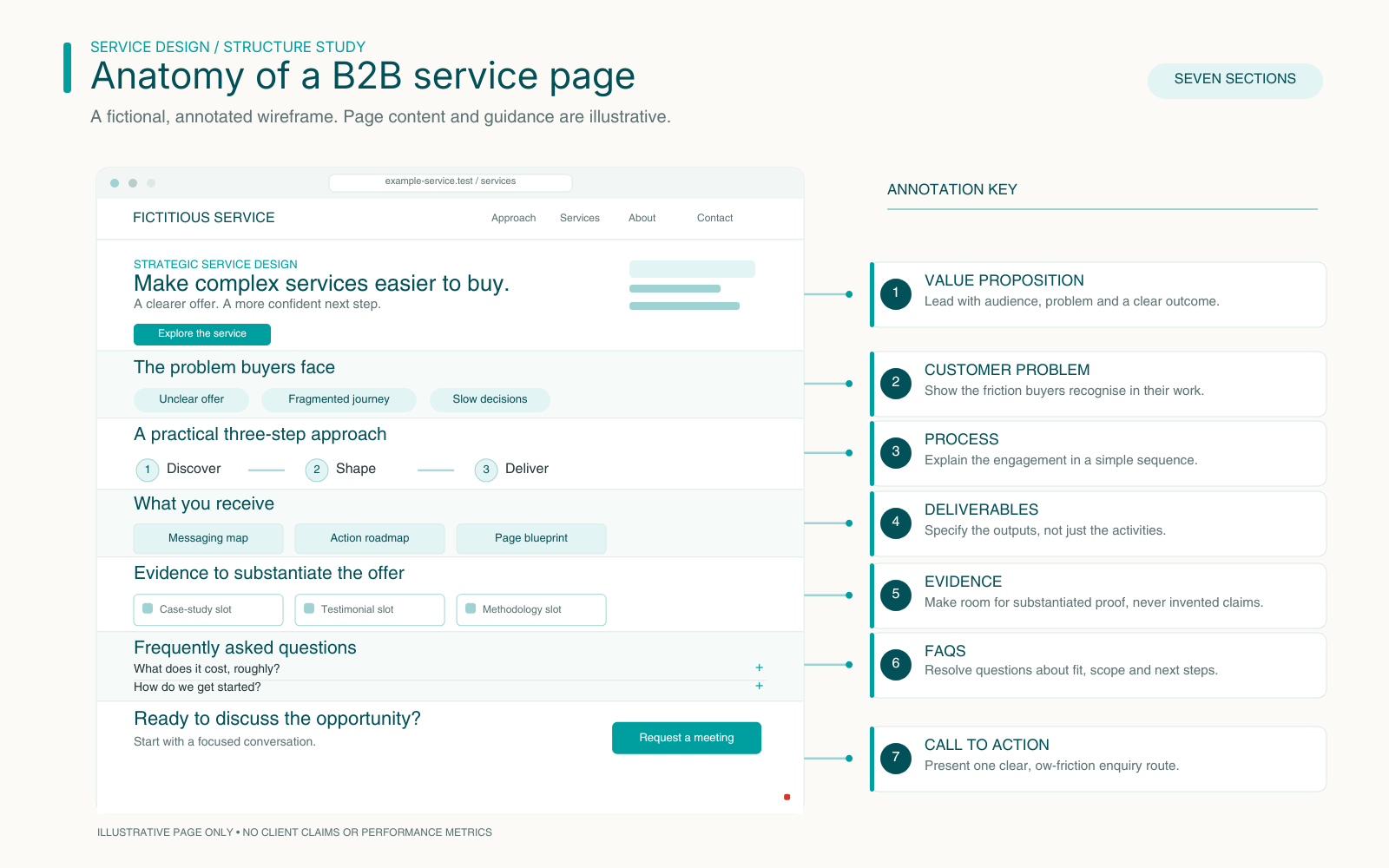
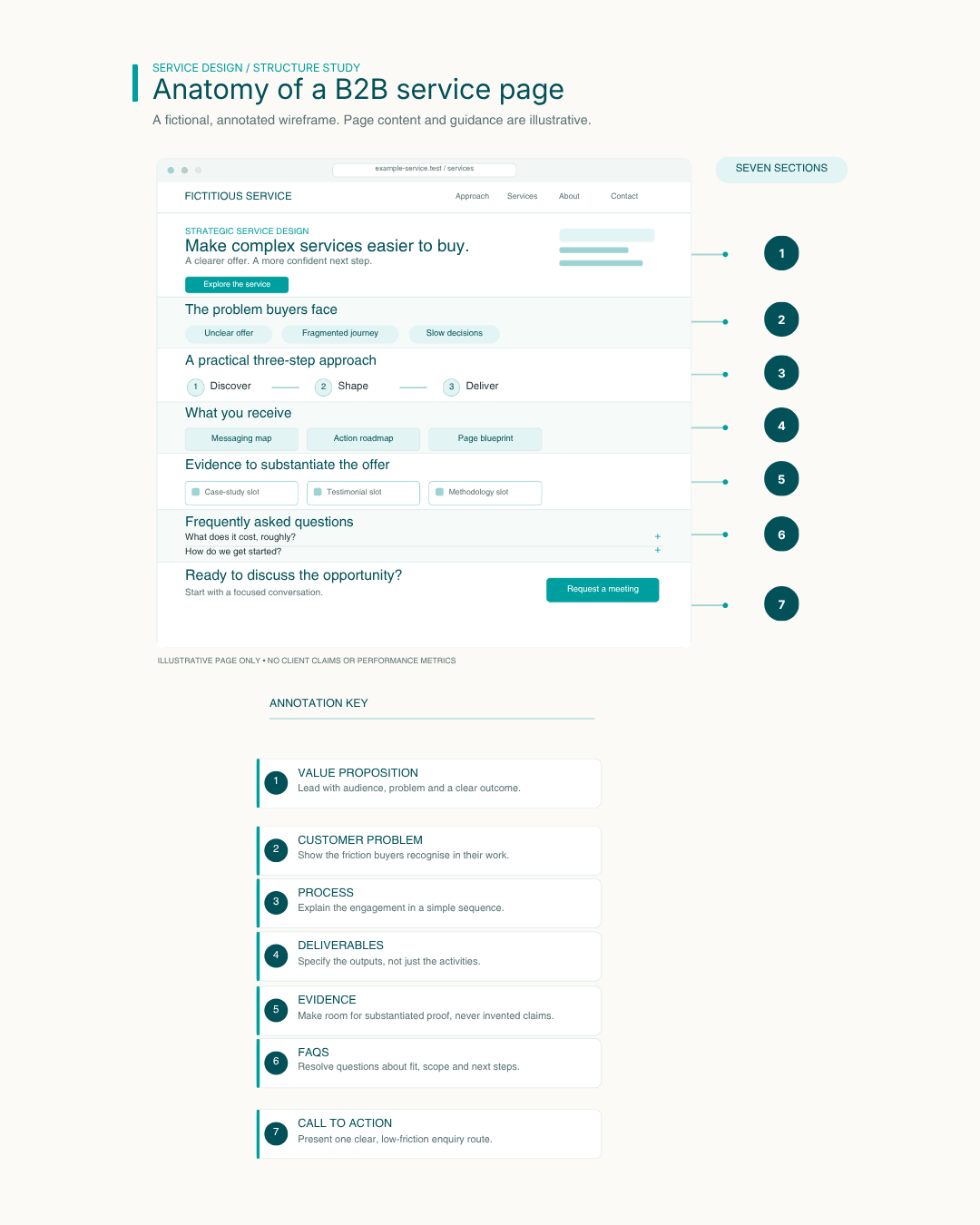
What a service page that sells covers, from the buyer's problem to one clear next step.
You do not have to publish a price list. However, a page that avoids every commercial question sends the buyer to someone who answers them.
Proof beats adjectives
"We deliver outstanding results" persuades no one. A case study that names the client, describes the starting point, explains what changed and gives the number does. Be honest about what the number measures, too. More traffic is not more sales, and a buyer who spots the difference will trust you less, not more.
Give every visitor a next step
"Contact us" is a fine button for someone ready to buy. Most visitors are not. In B2B, the person reading is often gathering options for a decision that involves three other people, a budget sign-off and a quarter of internal debate. So if you ask for a sales call on their first visit, they will simply leave.
Offer a step that fits where they are.
Researching the problem. A guide or a case study that teaches them something.
Comparing approaches. A clear account of how you work, and what it asks of their team.
Shortlisting suppliers. A review of their own situation, so they can judge you on their problem rather than your pitch.
Ready to buy. A short form or a calendar link, with nothing standing in the way.
That third step is why we built the Growth Snapshot: 21 checks on a company's marketing, benchmarked against three competitors it names, before anyone is asked to sign anything. A serious buyer gets something useful, and both sides get a proper reason to talk.
The form, and what happens after it
Every extra field costs you enquiries. For a first B2B conversation you usually need four things: name and work email, company and website, the problem, and the service they are considering. Ask about budget or timing only if the answer changes what you do next.
Then say what happens when they press send. A reply within two working days? A call? A written assessment? People hesitate when they cannot picture the next step, and one sentence under the button removes the doubt.
Then keep the promise. An enquiry that waits three days for a reply, or lands in a shared inbox nobody owns, was lost by the sales process, not the website. Every enquiry needs an owner, a record and a follow-up date.
B2B website lead generation is a system
Most companies can tell you their sessions, page views and traffic sources. Far fewer can tell you which channel brought in last quarter's best client. As a result, every budget decision is a guess dressed up as a plan.
Track the whole path, from first visit to signed contract.
Relevant visitors. People from the markets and sectors you serve, counted separately from everyone else.
Enquiries from key pages. Whether your service pages produce conversations, page by page.
Qualified enquiries. Whether the people writing in look like your clients.
Meetings, proposals and new clients. Whether enquiries turn into revenue, and from which source.
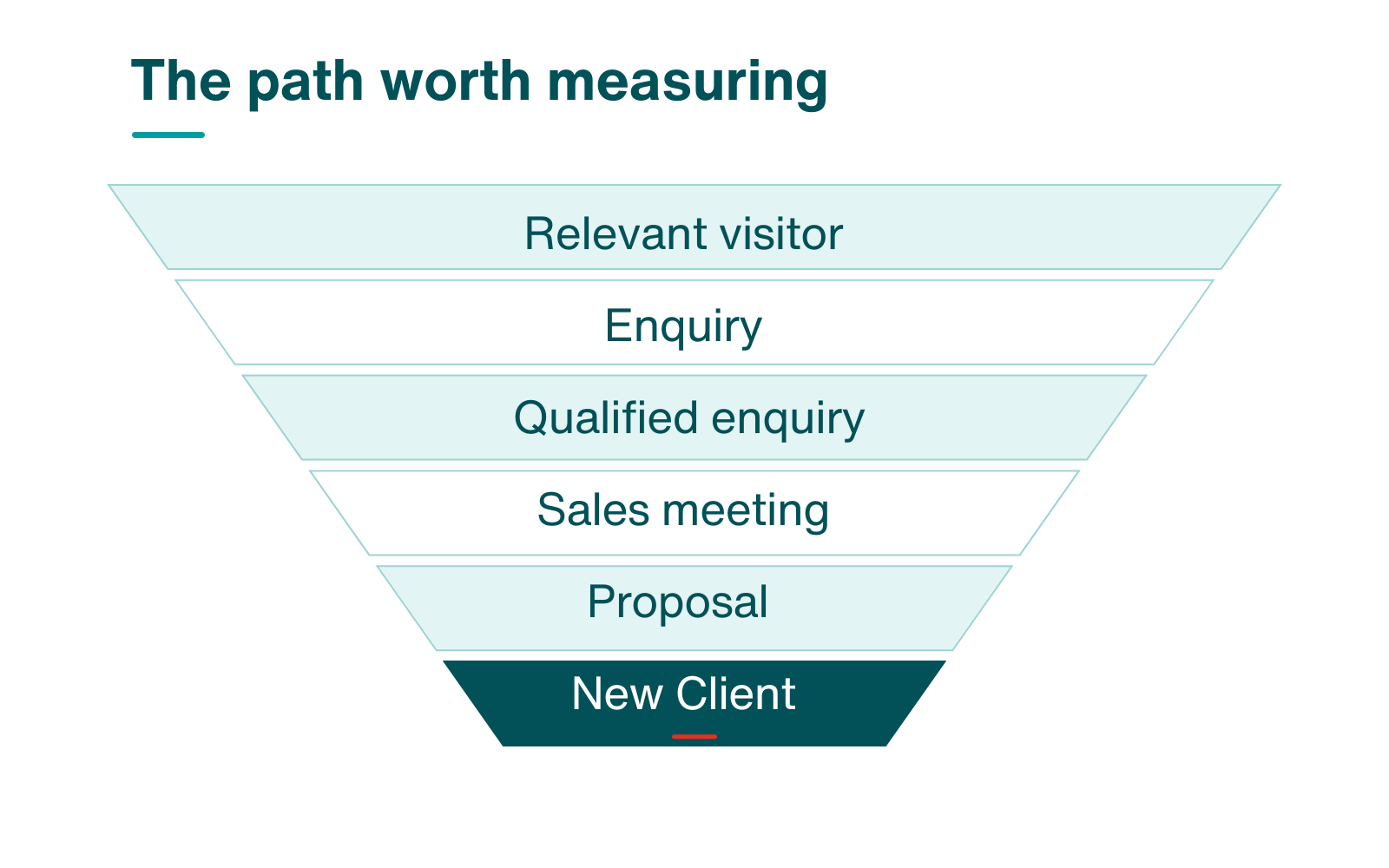
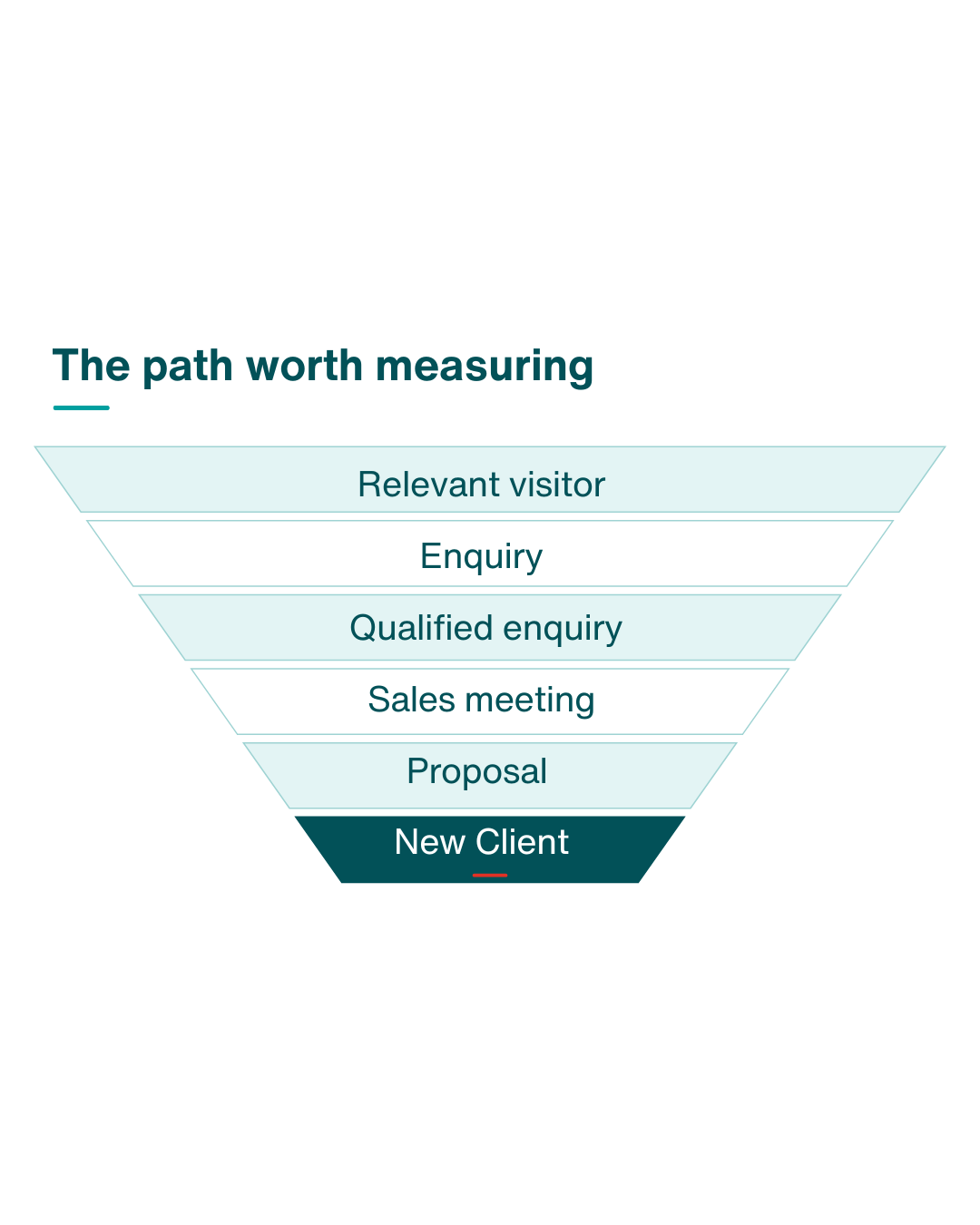
From first visit to signed contract: the path worth measuring, stage by stage.
Connect your analytics to your CRM, so the source of each enquiry travels with it all the way to the invoice. Review it every month, and change something because of what you see. A report that changes nothing is decoration.
Before you spend another euro on traffic, read your own website the way a buyer would: on a phone, between meetings, with no patience at all. Every place you hesitate is a place a buyer leaves.
Fix those first. The traffic you already have may turn out to be enough.